supplements · Teardown
IM8 Health
A premium, authority-heavy brand that does proof better than almost anyone — and already upsells in the cart. The CRO opportunity isn't credibility; it's decision load and a marathon product page that buries its best value.
 Shopify
 Klaviyo
 Rebuy
Rebuy Gorgias
IM8 has the trust layer most supplement brands only dream of — David Beckham, athletes, clinicians, NSF certification, a clinical comparison, and value-stacking done extremely well. The CRO opportunity isn't credibility; it's decision load and length. The first screen and the buy box ask a lot before the visitor has committed to the one thing that matters, and the product page is a marathon that buries its strongest value. Walkthrough, grouped by page.
Home page

The hero leads with an athlete ritual — "the MVP's most valuable routine," Giannis training and recovering — over premium imagery, with an "as featured in" press row close behind. It lands the brand instantly, but the specific substitution promise (one daily stack that replaces a shelf of supplements) competes with the mood for the first screen.
Fix: Keep the athlete credibility; make the substitution promise the single loudest line in the hero. Authority brands still need the one-sentence "what is it and what does it replace" above the fold.
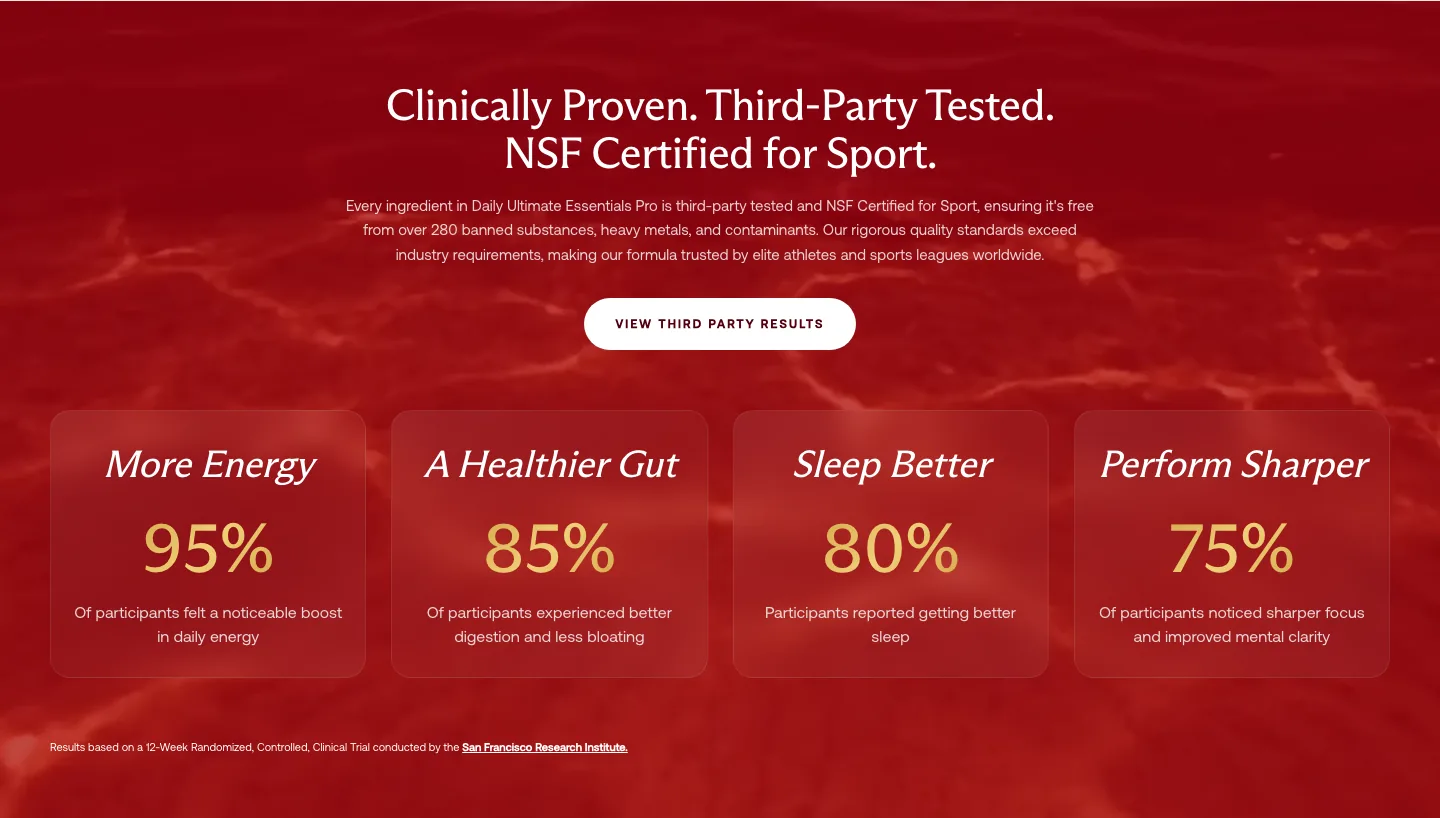
Strong, and worth protecting — "clinically proven, third-party tested, NSF Certified for Sport," a stat grid, clinician reviews, and 50M+ servings establish credibility early and credibly. This proof density is IM8's single biggest CRO asset.
Fix: Don't dilute it chasing a shorter page. The fix elsewhere is hierarchy and decision load, not trust — keep the evidence loud.
Product page
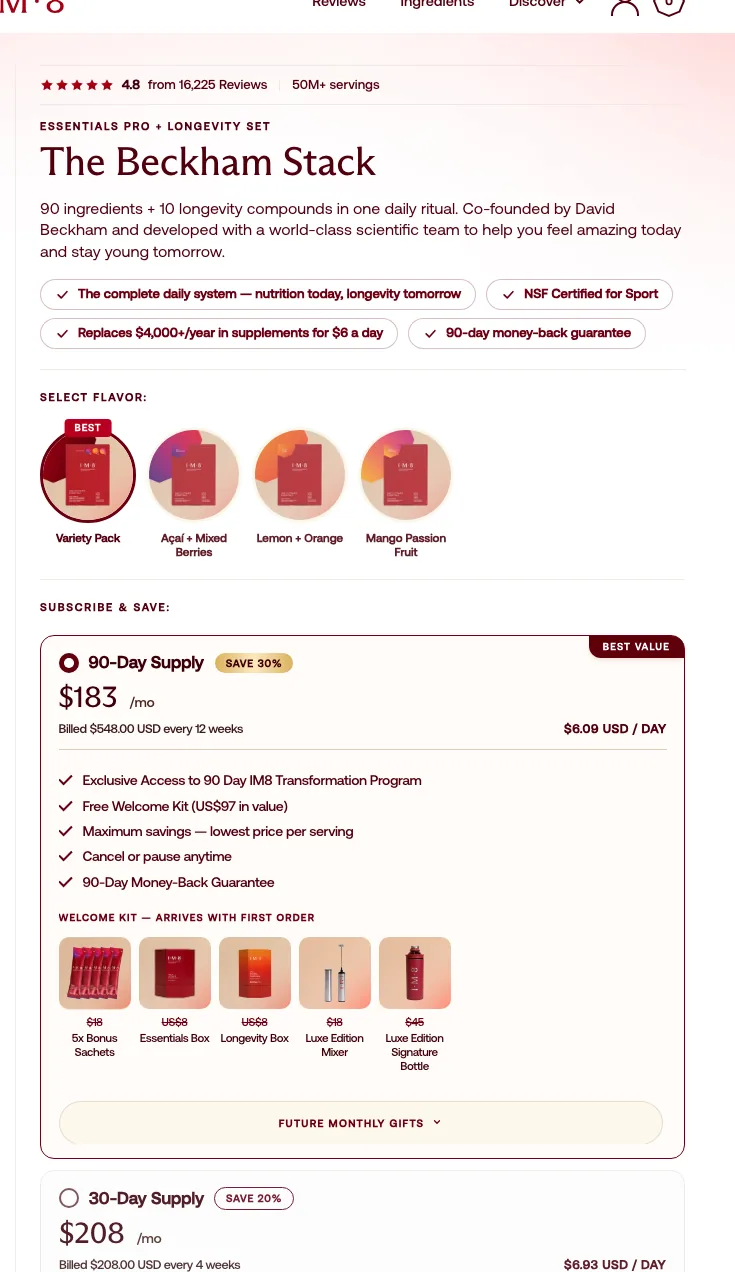
The buy box stacks several choices at once — variant (Essentials Pro + Longevity), a four-way flavour picker, 90-day vs 30-day subscription, and a welcome-kit gift list — all before a first-time buyer has decided to buy. That's decision load piled on the hardest decision. The 4.8-from-16,225 rating and the guarantee are doing good work up top.
Fix: Pre-select the recommended 90-day plan with a clear "Best value" tag and visually demote the rest. Make the default the easy yes; let everything else be a deliberate change, not a required choice.
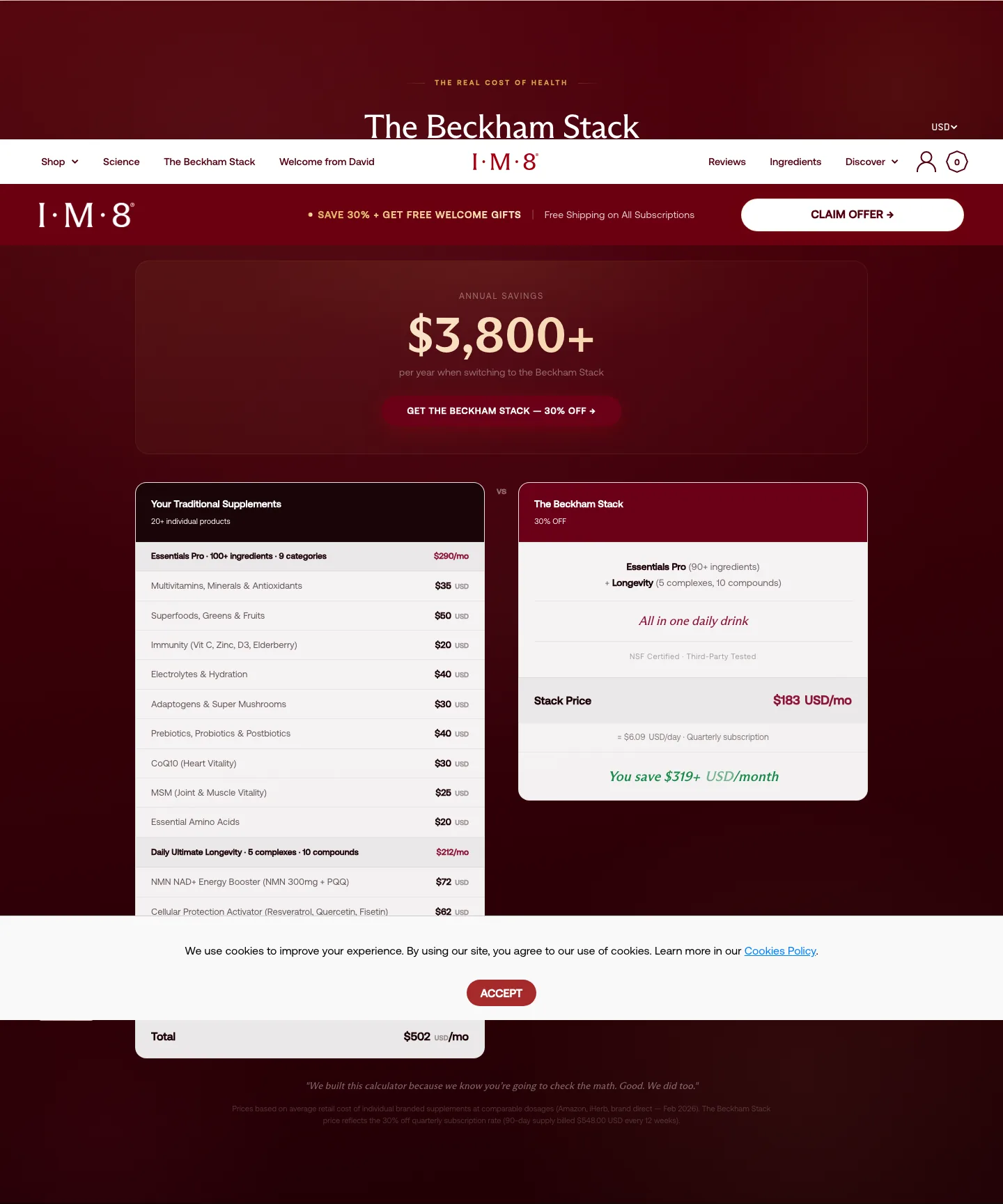
The product page is extremely long — dual-formula explainer, clinician reviews, a nine-organ-system breakdown, the cost comparison, a Beckham note, a scientific advisory board, FAQs. The material is excellent, but the buy box scrolls out of reach fast, especially on mobile, and the strongest value sits a long way down.
Fix: A Baseline rebuild adds a sticky mobile buy-bar so the decision is always one tap away, and restructures the scroll so proof and value support the buy box instead of trailing far behind it. This is page-system work, not a trust problem.
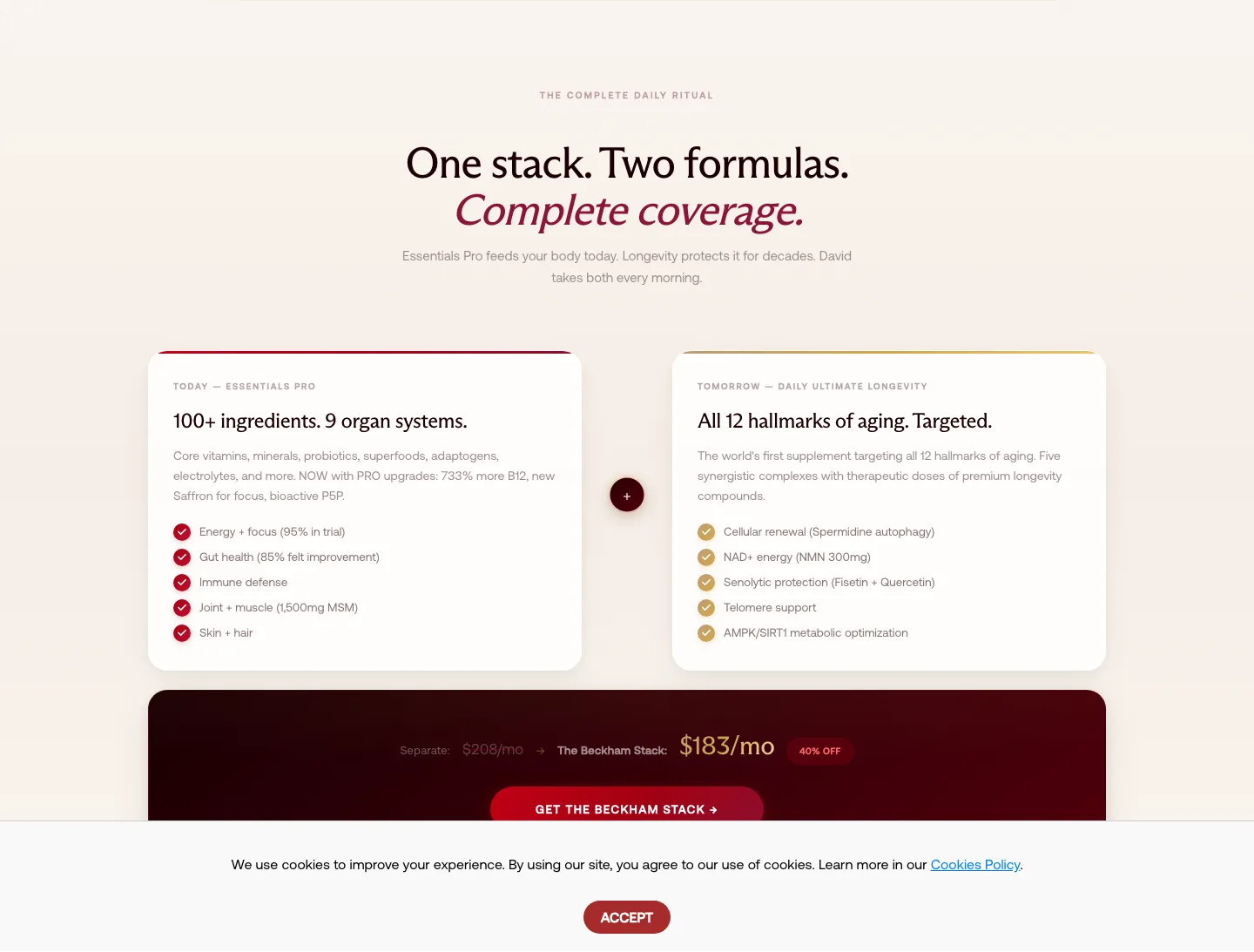
The "complete daily ritual — one stack, two formulas" framing and the "$4,000+ a year, replaces 20+ supplements" math are genuinely strong techniques, well executed. But they live mid-to-deep in the page, far from where the buyer decides.
Fix: Pull a condensed version of the value-stack up beside the buy box. Surfacing the strongest value framing at the decision point is core Baseline work — it makes the price feel earned before the visitor scrolls away.
The buy box does subscription and welcome-kit gifting well, but there's no low-ticket impulse add-on beside Add to Cart — nothing like a shaker, a travel single-serve pack, or a second-product trial to nudge the first order up or de-risk it.
Fix: Add one Upsellr bump (Product/Bump, Compact) next to Add to Cart — a shaker or a travel 7-pack. Keep it cheap and obviously useful; it shouldn't compete with the stack decision, just add to it.
Cart drawer
The cart drawer already runs more than most — a free-shipping reward bar and a "Complete your stack" cross-sell (the store is on Rebuy). The issue isn't presence, it's fit — the cross-sell leans toward an accessory (a travel pouch) rather than a consumable that drives the next order.
Fix: Keep the reward bar; re-point the cross-sell at a consumable — a refill, a flavour single, a travel sachet pack — so the cart upsell compounds replenishment rather than one-off accessory margin. Upsellr can target it off the active stack.
With the cart already this capable, the bigger miss is what comes after — there's no one-click offer on the post-purchase window, the highest-intent moment on a premium, trusted brand.
Fix: Add an Upsellr one-click post-purchase offer on the thank-you page (a travel pack or a complementary single) — no re-entry of payment. Margin-check the discount against the stack's COGS, since the stack already carries bundle pricing.
The drawer lifts order value (reward bar, cross-sell) but it doesn't carry the trust the page worked so hard to build — there's no recap of the 90-day money-back guarantee or the value-stack at the final step, where last-second hesitation lives.
Fix: Add a one-line guarantee plus a condensed value recap inside the drawer so the momentum from the product page doesn't evaporate at checkout. The reward bar is already there — reinforce the decision, don't only upsell it.
Screens


What I'd fix
- 1Add a sticky mobile buy-bar so the decision stays one tap away through the very long product page.
- 2Surface a condensed value-stack ("replaces 20+ supplements / $4,000+ a year") and a proof capsule directly beside the buy box, not only deep in the page.
- 3Pre-select the recommended subscription and visually demote the alternatives so the default is the easy yes, not another decision.
- 1Add one low-ticket impulse bump beside Add to Cart (a shaker or a travel single) — the buy box is all recurring plans with no cheap entry.
- 2Keep the cart reward bar, but swap the "Complete your stack" accessory cross-sell for a consumable (a refill or a flavour single) so it compounds reorders.
- 3Add a one-click post-purchase offer on the thank-you page — the highest-intent moment after a premium purchase is currently empty.
Want this fixed on your store?