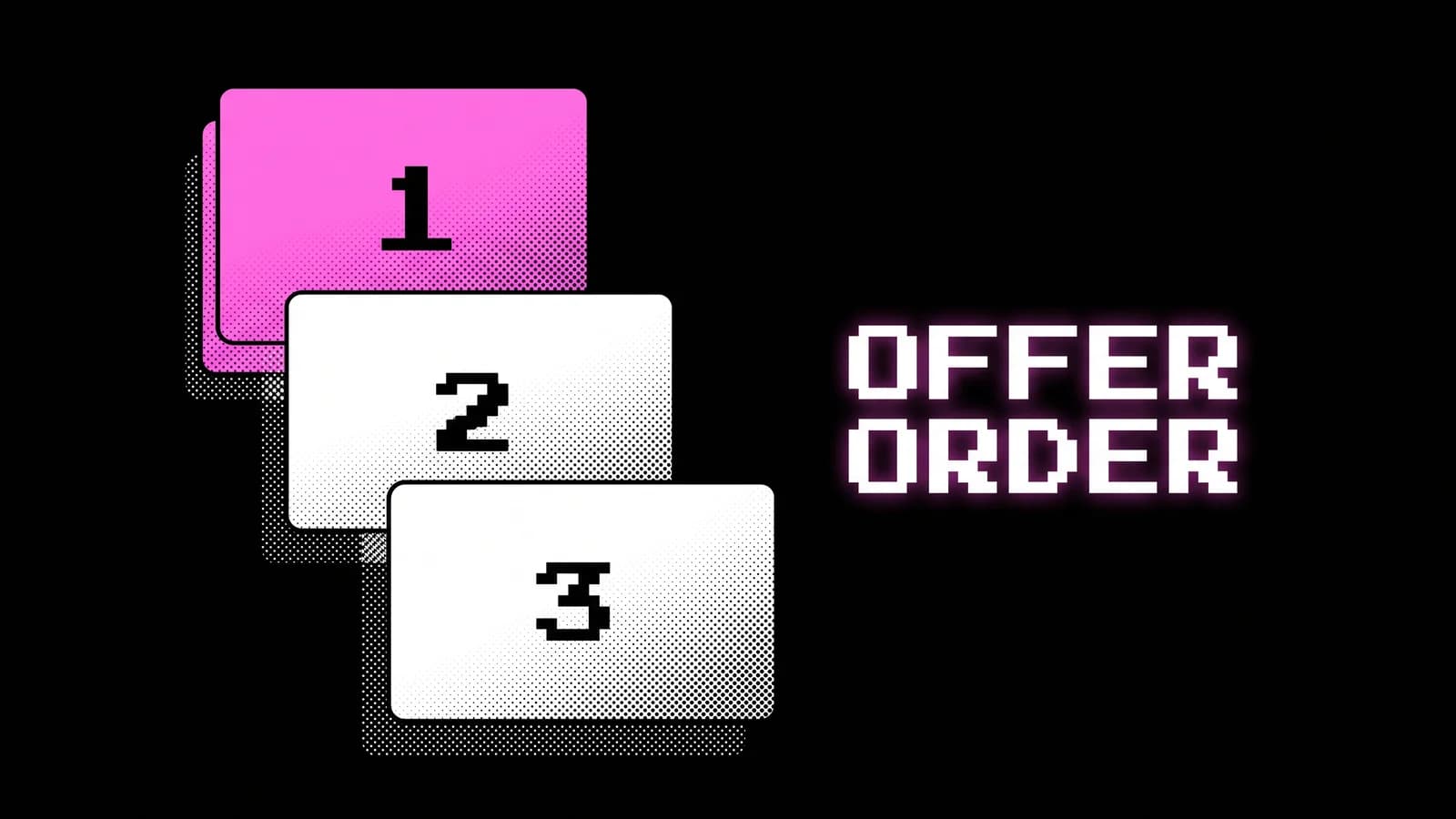
The order of your post-purchase offers matters more than which offers you pick. Most stores that run post-purchase upsells show one offer, or stack them by price with the biggest one first. Both leave money on the table. The offer that should go first is the one with the highest expected value, which is take-rate times margin, not the one with the highest sticker price.
This is a sequencing guide. For the one-tap mechanic, see the one-click post-purchase upsell guide. For the platform setup, see the post-purchase offer setup guide. This post is about the hierarchy: what to offer first, what follows a decline, and how the order shifts by category.
I run Skuology and build Upsellr. This comes from 80+ Shopify projects and over $100M in combined eCommerce revenue, including a Mountain Ice offer that took AOV from $45 to $73. Post-purchase offers are the load-bearing layer of the Invisible Second Sale™: revenue earned after the customer has already paid.
TL;DR
- Order post-purchase offers by expected value, which is take-rate times margin, not by price.
- Slot one is the obvious complement, sized ~30–50% of the cart.
- Slot two is a smaller add-on or variant, the easy yes after a decline.
- Slot three is a retention nudge like subscribe-and-save.
- The hierarchy stays the same across categories, but which offer earns slot one shifts with how the category repurchases.
Why the order matters more than the offer count
Post-purchase one-click offers convert at 5–15% (cartylabs, 2026). That range is the whole reason ordering matters. Every slot in the sequence sees fewer buyers than the one before it, because some accept and some leave. So the offer you put first gets the most eyes at the highest-trust moment. Spend that slot well.
Two stores can run the exact same three offers and see different revenue purely from the order. The store that leads with its highest-take-rate offer captures more acceptances in slot one, where attention is highest. The store that leads with its priciest offer captures fewer, because price is the friction that peak trust was supposed to overcome.
The count matters too, but less than most people think. One offer stops at the first no. Three offers, ordered badly, still underperform two offers ordered well. Get the order right first, then add slots.
The hierarchy: rank by expected value, not price
Here's the ranking rule I use on every post-purchase build. Score each candidate offer by expected value:
Expected value = likely take-rate × margin per acceptance.
Say a $19 complement takes 12% at 70% margin, against a $90 add-on that takes 2% at 40% margin. Run those hypotheticals and the cheaper offer wins slot one on expected value. That's the mistake price-first ordering makes: it optimizes for revenue per acceptance and ignores how few people accept.
Order the offers by that score, highest first. The sequence almost always steps down in both price and commitment as it goes:
- Slot one: the obvious complement. Highest take-rate, solid margin, lowest friction.
- Slot two: the smaller yes. A lower-priced add-on or a variant, shown after a slot-one decline.
- Slot three: the retention nudge. Subscribe-and-save or a loyalty offer, which converts the buyer who already likes the product.
Each step is still one tap, so a longer sequence never adds real friction. A declined offer costs nothing. An accepted one adds margin. The order is what makes the whole thing compound.
Slot one: the obvious complement
The first offer is the one that most naturally pairs with what they just bought, sized at roughly 30–50% of the original cart value. Mountain Ice ran a single post-purchase offer at about 40% of cart value and took AOV from $45 to $73. That offer worked because it read as the natural next thing, not a random add-on.
Slot one has three jobs. It has to be related, so it makes sense given the order. It has to be sized to feel easy, anchored well below the purchase they just made. And it has to hold its own margin, because a deeply discounted complement can add revenue while erasing profit.
What never belongs in slot one is the same item again, or a bigger version of it. The buyer already solved that need. The complement is the thing that goes with the solution, not more of the solution.
Slot two: the smaller yes
Slot two only appears if slot one is declined. Its job is different: it's the easy yes for the buyer who just said no. So it steps down in price and commitment.
Good slot-two offers are a lower-priced add-on, a smaller pack size, or a try-the-other-variant pitch. The buyer who passed on a $40 complement might tap yes on a $12 accessory. The decline told you the first offer was too much, not that the buyer is done. Meet them lower.
Keep slot two genuinely smaller. If it's the same size as slot one with different framing, you're asking the same question twice, and the second no comes faster than the first.
Slot three: the retention nudge
Slot three is where the offer stops being about this order and starts being about the next one. For consumables, subscribe-and-save converts well here, because the buyer already chose the product and the only question is cadence. For non-consumables, a loyalty enrolment or a small credit toward a future order does similar work.
This slot rarely carries the most revenue today. It earns its place by lifting repeat rate, which is worth more over a customer's life than a single add-on. Order it last because its expected value on this order is lowest, but don't drop it, because its value shows up on order two.
How the order changes by category
The slot logic holds across every store. Which offer earns slot one is what shifts, and it shifts with how the category actually repurchases.
- Consumables (supplements, skincare, coffee, pet). Lead slot one with a restock multi-pack or a subscribe-and-save, because repeat need is real and near-term. Here the retention offer can climb from slot three to slot one.
- Considered one-time purchases (electronics, tools, furniture). Lead with an accessory or a protection or warranty add-on. There's no near-term repurchase, so slot one is about completing the use case.
- Apparel and accessories. Lead with a complete-the-look complement or a second color of what they bought. The complement take-rate is high because the buyer is already in a styling mindset.
Same hierarchy, different slot-one winner. Score your real offers by expected value inside your own category and the order sorts itself.
The mistake: leading with your most expensive offer
The most common ordering error is putting the highest-priced offer first, usually because it looks like the biggest revenue opportunity. It isn't. It's the offer least likely to be accepted, placed in the slot that sees the most buyers. That's backwards.
The second most common error is showing one offer and stopping. One offer captures one take-rate and ends at the first no. There's no downside to a second and third one-tap offer, so stopping at one leaves the compounding on the table.
Order by expected value, sequence two to three, and step down in price as you go. That's the whole system. No guaranteed lift, because take-rates depend on your offer, product, and margins. What I can promise is that the order is the cheapest variable to fix and one of the highest-impact.
Shopify post-purchase offer order FAQ
What should I offer first as a post-purchase upsell?
Lead with the obvious complement to what they just bought, sized at roughly 30–50% of the cart. That offer has the highest expected value because it reads as helpful, not pushy. Rank offers by expected value, which is take-rate times margin, not by sticker price. The most expensive offer is rarely the one that should go first.
How many post-purchase offers should I show, and in what order?
Two to three, ordered by declining expected value. Slot one is the obvious complement. Slot two is a smaller add-on or a variant, the easy yes for someone who passed. Slot three is a retention nudge like subscribe-and-save. Each is still one tap, so the sequence never feels like a gauntlet.
Should the biggest offer go first or last?
Rarely first. Leading with your highest-priced offer spends the peak-trust moment on the offer most likely to be declined. Put the high-expected-value complement first, then let the price and commitment step down. The order that wins is ranked by take-rate times margin, not by which offer earns the most per acceptance.
Does the post-purchase offer order change by product category?
Yes. Consumables lead with a subscribe-and-save or a restock multi-pack because repeat need is real. Considered one-time purchases lead with an accessory or protection add-on. Apparel leads with a complete-the-look complement or a second color. The slot logic stays the same, but which offer earns slot one shifts with how the category actually repurchases.
What is the most common post-purchase offer ordering mistake?
Leading with the most expensive offer, or showing only one. Both waste the highest-converting surface on Shopify. One offer stops at the first no. A price-first order burns peak trust on your lowest-take-rate offer. Order by expected value and sequence two to three, and take-rate compounds instead of stalling.
What to do next
The offer order is the cheapest variable in your whole post-purchase setup to fix, and one of the highest-impact. Score your offers by expected value, put the complement first, and step down from there.
The hierarchy is the sequencing layer of the Invisible Second Sale™. For the one-tap mechanic behind it, see the one-click guide. To deploy a sequenced post-purchase offer in 48 hours, buildmyupsell.com runs Upsellr under the hood, or book a call for the full architecture.